The Best Table of the Week Is Set for Eleven
Saturday morning has a rhythm you can hear from the pavement: shutters going up, a van reversing into a loading bay, the first coffee of the day coming out of a machine that hasn't quite woken up. By eleven, the high street has filled in. By half past, the good tables are gone.
We spend a strange amount of energy on Saturday night — the booking made three weeks ago, the outfit, the taxi at a quarter to eight. Meanwhile the most sociable, least fussy, most reliably good meal of the week happens in daylight, in a room that smells of coffee and toast, and costs a fraction of what follows it.
Brunch gets treated as a compromise: too late for breakfast, too early for lunch, an excuse to drink before noon. That undersells it badly. The late-morning table is where a neighbourhood actually meets itself.
Why eleven o'clock beats eight o'clock
Dinner is a performance. There's a right time to arrive, a right number of courses, a sense that the evening should build to something. Brunch has none of that. Nobody is impressed by you at eleven in the morning, which is precisely the freedom of it.
At a Saturday table you'll see the same street in a different order. A couple with a paper between them, not talking, entirely comfortable. Two friends who've clearly been meaning to do this since August. A grandparent, a toddler, a plate of toast cut into fingers. Someone on their own with a coffee and a book, unhurried because nobody is waiting for the table. Dog walkers with wet boots. The post-run crowd, the post-market crowd, the people who've just got off a shift.
That mixture is the whole point. It's the closest thing a high street has to a village square, and it costs the price of breakfast.
Coffee is the point, not the warm-up
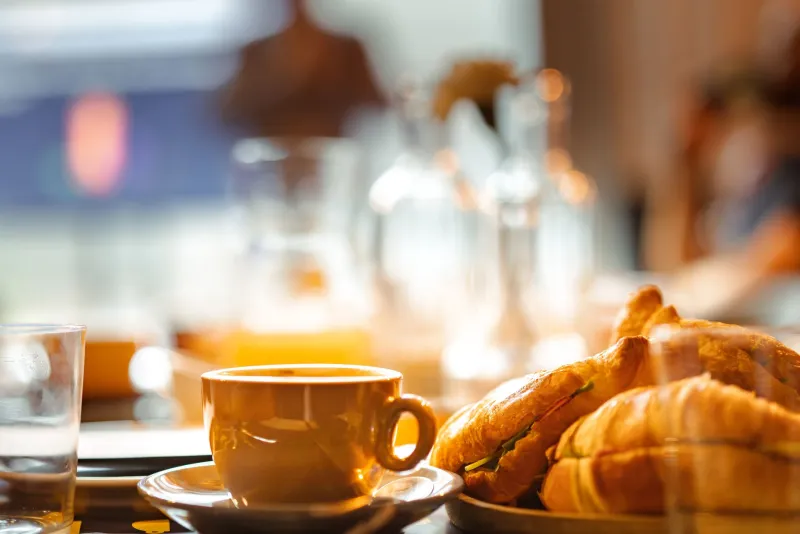
A good brasserie treats the coffee as part of the meal rather than a transaction to be cleared away. That means a proper cup, served in something with a handle, and a second one arriving before the first is finished — not after a long hunt for eye contact.
If you drink alcohol, a bloody mary or a glass of something cold and dry is a fine choice at this hour. If you don't, the coffee should be good enough that you don't feel you're missing out. That's a test of a kitchen's confidence, and it's one worth applying before you commit to a Sunday lunch somewhere else.
How to build a brunch order that doesn't defeat you
Brunch menus are generous and the eyes are bigger than the morning. A few rules of thumb, learned the hard way:
Lead with savoury. Sweet plates are lovely and rarely satisfying on their own at eleven. Order the eggs, the mushrooms, the fish, and let something sweet come second — or be shared.
Order one thing to share, not four. A pastry for the table, a side of greens, a dish of something pickled. Sharing one thing makes the table feel like a table; sharing everything turns it into a buffet with extra steps.
Ask what's come in this morning. The answer tells you more about the kitchen than any description on the page.
Order the second coffee on arrival of the first. You will want it. Waiting until you want it means waiting twenty minutes.
Leave room for the walk home. The best Saturday mornings end slightly early, with a bit of appetite left for whatever the afternoon turns into.
What's good before noon in November
Late autumn is an underrated brunch season. The produce has weight to it — roots, brassicas, orchard fruit, the last of the hedgerow — and the weather makes a hot plate feel like a kindness rather than a habit.
Baked eggs with leeks and a sharp cheddar, the leeks softened slowly until sweet. Smoked haddock under a rarebit crust, mustard enough to wake you up. Roast squash on toasted sourdough with sage browned in butter. A hash of potato and black pudding with apple to cut it. Mushrooms on toast with tarragon, cooked until they've given up their water and started to colour.
On the sweet side, something with pear and oats, or a warm bun with salted butter and nothing else competing for attention. This is also the season when the bakery down the road is doing its best work — the bread is heavier, the pastries darker, and the whole room smells of it.
Why a brasserie suits the hour
A brasserie is built for the in-between. All-day kitchens, proper tables rather than perching stools, a wine list that doesn't disappear at noon, staff who don't hover and don't vanish. You can come in for a coffee and a croissant and be gone in twenty minutes, or you can sit for two hours and watch the street change its mind about the day.
That flexibility is not a small thing. Most restaurants make you choose a mood before you've sat down. A good neighbourhood brasserie lets the morning decide.
The polite art of not leaving
There's a British awkwardness about occupying a table after the plates are cleared. Ignore it. On a Saturday morning the table is yours until you've finished the coffee, and the room is better for a bit of lingering. Order another drink if you feel guilty; that's what the second pot is for.
The Saturday table is the cheapest ritual we have. No booking anxiety, no dress code, no getting home at midnight. Just a warm room, a good cup, and the person across from you with nothing in particular to do afterwards.
Book it for eleven. You'll get the good seat.